

LTD «Agricultural Company-2004»: NEW HORIZONS!
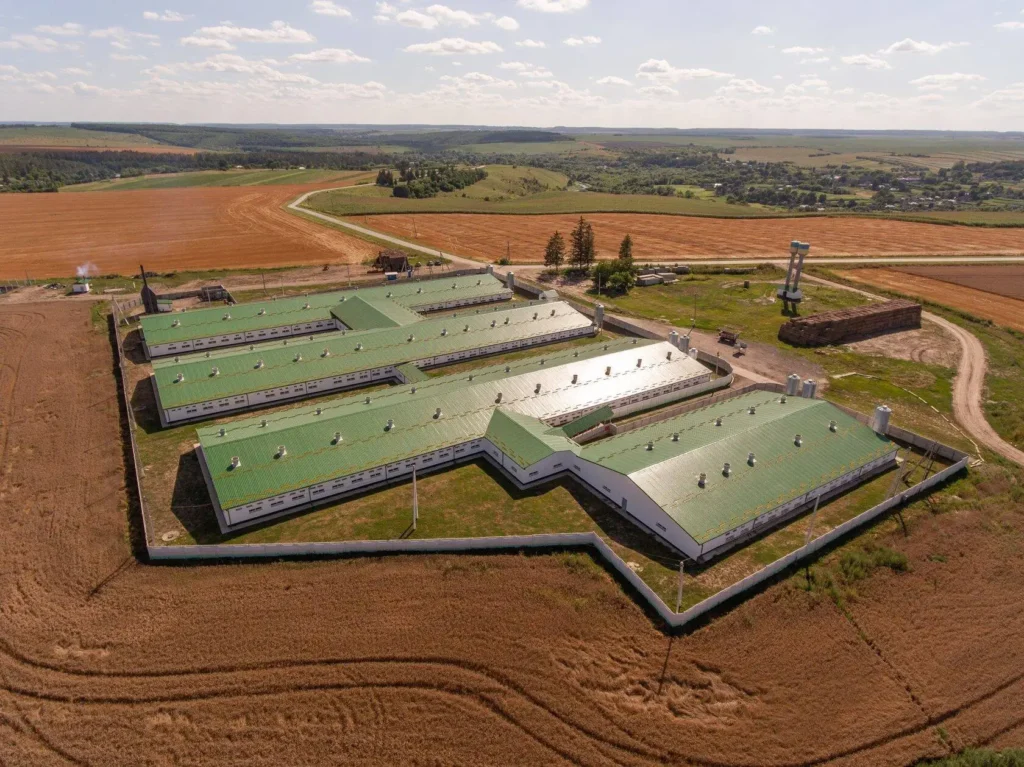
The enterprise “Agricultural Company-2004” is among the top 10 leaders in the domestic market in terms of the volumes of maintained breeding stock and the sale of market-ready pigs. Discussions on new challenges and development prospects were held with the Director of the Swine Department, Dmytro Dubovykov. The conversation was conducted by Volodymyr Yatsulchak, editor of the “Profitable Swine Breeding” magazine.
REFERENCE
LLC “Agricultural Company 2004” is a powerful domestic pig farming enterprise located in Khmelnytskyi region. It is part of the vertically integrated structure of the VITAGRO group of companies. The company has been involved in the swine business since 2010. The land bank of the group of companies is 85 thousand hectares. Among other areas of activity are dairy farming, horticulture, crop farming, seed plant, elevators, and its own service structures: a fleet of machinery, engineering service, construction department. According to the ranking of pig farming prepared by the analytical department of the Association “Pig Breeders of Ukraine”, LLC “Agricultural Company 2004” ranks 10th among the TOP-50 leaders of the domestic pig farming industry of Ukraine. The enterprise is a member of the Association “Pig Breeders of Ukraine”.
DMYTRO DUBOVYKOV
 The Director of the Swine Department of LLC “Agricultural Company 2004” is Dmytro Dubovykov..
Born in 1978 in Stakhanov (Luhansk region), he graduated from the Luhansk State Agricultural University with a degree in Zootechnics. He also obtained a second higher education in accounting and auditing at the same university. He pursued his postgraduate studies at the Institute of Animal Science of the National Academy of Agrarian Sciences of Ukraine (Kharkiv).
He gained practical experience on pig farms in Denmark, where he also acquired management experience. Upon returning to Ukraine, he worked as a head of the reproduction department and later became the production director at the PJSC “Slobozhansky Agrarian Corporation.” He gained experience in the dairy industry at LLC “Astarta-Kyiv.” Since pig farming is his passion, he accepted the offer and became the director of LLC “Ranch” (“Рантьє”). Since 2017, he has been the director of the Swine Department at LLC “Agricultural Company 2004” within the VITAGRO group of companies.
— What prompted you to start breeding work?
— First of all, the desire not to depend on fluctuations in genetics prices. As it is known, the cost of breeding pigs is constantly increasing due to demand from China, which is restoring its population lost due to ASF. Considering the volume of this market, such a trend will persist for a long time. Our enterprise, constantly developing and increasing the pig population, does not want to depend on external factors. Opening new complexes creates the need for young animals both for equipping new farms and for replenishing the existing population. That is why we decided to have our own nucleus in Ukraine.
By investing in this direction, we realized that we could offer the market quality breeding stock. The company does not change its main profile—it will continue to engage in the production of market-ready pork. At the same time, we will be ready to supply breeding animals of Canadian genetics to the market.
— Your enterprise is a “pioneer” that was the first in Ukraine to import and start working with Canadian genetics. What prompted this choice?
— It’s no secret that in recent years Ukraine has faced significant brain drain. Therefore, the question arose of choosing genetics that are more robust and resilient to the conditions of maintenance with minimal intervention from personnel. This compelled us to thoroughly study the offerings in the genetic resources market.
Pigs of Canadian genetics are characterized by a sturdier constitution and are less whimsical. At the same time, the supplying company declares high production results and performance indicators. To verify their reliability, we visited several farms in Canada. Domestic producers won’t have to travel so far—they will be able to get acquainted with this genetics on our production sites. They will have the opportunity to see the animals themselves and verify the declared figures in the conditions of real production.
Another argument in favor of Canadian genetics is the high taste qualities of pork. And although the domestic market still operates under the Soviet approach—producers are paid based on the quantity of live weight sold, not the quality of the carcass—we are convinced that consumers will prefer meat with better taste indicators if given the choice.
— How many head of breeding stock will the nucleus start with?
— Today we have 650 purebred sows of the Large White breed. This is the first step towards implementing the plan to increase the breeding stock of the enterprise from 5.3 to 11.5 thousand sows in the coming years. One of the main challenges in its implementation is to have a team of professionals who know how to work with animals. And although pigs of Canadian genetics are easy to manage and care for, basic training is still necessary.
Therefore, we are considering organizing a school for personnel training based on our farm. Thanks to this approach, every enterprise that wishes to purchase Canadian genetics will be able to obtain the necessary knowledge and support.
— Will some of your farms continue to work with Danish genetics, while the rest will work with Canadian, like two different structures?
— Yes, the genetics are different, but the capacities of the newly built compound feed plant allow us to simultaneously produce a wide range of formulations to meet the needs of each genetics.
The qualification of personnel is also important, so we will allocate specialists according to their level of training. For Canadian genetics, basic knowledge is sufficient due to the endurance of these animals, genetically embedded. Experienced specialists who know how to achieve production goals will work on complexes with Danish genetics.
This way, we can ensure the optimal cost of cultivation using two technologies.
— Did you consider the American option for the company’s development: using the services of feeder farms?
— If we consider the advantages of such a model—you don’t invest in “bricks” since you essentially lease a farm and pay for the space. However, there are also significant risks: we will provide breeding stock, feed, and veterinary support, but we won’t have guarantees of the quality of care for the animals. Domestic practice shows that confidence in the results can only be achieved when there is control, rather than relying on others. Undoubtedly, success can be achieved through partnership, but it is more reliable to build independently than to search for partners and “weed out” based on the results of cooperation.
In the company’s strategic plans—complete vertical integration of production. The final stage of development of the pig farming direction is a meat processing plant. To implement the strategy in the near future, we will develop the breeding direction, build new pig complexes, and increase the number of sow herds.